



The holidays are heralded as a time of warmth, family, celebration and tradition. But for many families, this season can bring deep pain, sharp reminders of absence, and renewed grief. At Royal Hospice, we see firsthand how the combination of loss and seasonal expectations creates a complex emotional landscape. Our aim with this guide is to support families and loved ones by offering insight, tools, and compassion so that grief can be acknowledged, honored and integrated, not ignored.

Why the Holidays Can Be Especially Difficult
There are several reasons why grief often intensifies during the holiday season:
- The routines of celebration, togetherness and tradition bring into sharper focus the person who is no longer present.
- The cultural “should(s)” of joy and togetherness can clash with inner experience of sadness, loss or emptiness, creating a sense of being out of sync.
- Physical, environmental and social factors (e.g., colder weather, shorter days, more time at home, or fewer distracting commitments) provide space for grief to surface.
- Deaths and losses themselves tend to cluster around the end-of-year season. For example, studies have shown that deaths from natural causes increase by up to 5 % during the late November–early January holiday period.
- A 2021 survey found that 36 % of Americans said they did not feel like celebrating the holidays that year because of feelings of grief or loss. GlobeNewswire+1
- According to the National Alliance on Mental Illness (NAMI), a 2021 survey found that 3 in 5 Americans say their mental health is negatively impacted by the holidays. NAMI
All of this underscores one very important truth: If you’re grieving this holiday season, you are not alone, and your experience is valid!
Understanding Grief: It’s Not One Size Fits All
Grief is highly individual. While many people reference the “stages” of grief, experts emphasize that there is no single path or timeline. For example:
- According to the University of Alabama at Birmingham (UAB) article “Grief during holidays: stages, types and coping tips,” grief can “ebb and flow,” and there’s no set endpoint or linear progression.
- The same article outlines types of grief such as anticipatory grief (when a loss is expected), disenfranchised grief (when loss is unrecognized), cumulative grief (multiple losses), and traumatic grief (abrupt or violent loss).
In the context of hospice and palliative care, families may be dealing with:
- Recent loss of a loved one under our care.
- Anticipatory grief (when a loved one is receiving end-of-life care).
- Multiple overlapping losses (changing health, role loss, loss of identity).
- Traditional holiday roles and expectations that no longer apply.
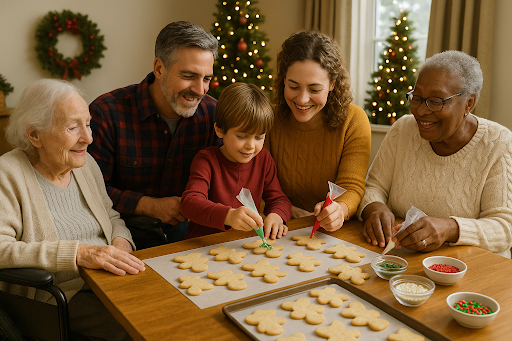
The “Holidays + Grief” Unique Challenges
Here are specific factors families may face when grieving during the holiday season:
- Triggers and Memory Intensification – Old photographs, favorite songs, previous celebrations, empty chairs—anything can spark a wave of emotion. One article notes that grief “can feel compounded during the holidays” because of constant reminders of family togetherness and tradition.
- Isolation or Pressure to “Be Happy” – When everyone else seems to be celebrating, someone grieving may feel disconnected or guilty for feeling sad. The UAB article emphasizes how the pressure of “should do” or “should feel” can exacerbate pain. University of Alabama at Birmingham
- Changing Traditions – Traditions are a core part of the holidays, and when a loved one is gone, these change—sometimes dramatically. According to Mental Health America (MHA), “It’s okay to be sad when traditions change.” Mental Health America
- Compounded Stress – Holidays bring logistical demands, financial pressure, extra social commitments, and physical fatigue. For someone grieving, these can be additional burdens.
- Health / Physical Impacts – Grief impacts the body too: disrupted sleep, appetite changes, heightened anxiety, and even immune effects. While specific hospice-population studies are limited, recognizing this connection is crucial.
Practical Strategies for Families and Individuals
At Royal Hospice, we believe that grief is not something to “be fixed” but to be supported and integrated. Here are practical strategies you can use now during the holidays:
- Self-Compassion over “Doing It Right”
- Accept your feelings. It’s okay to feel joy and sadness at the same time. The emotional truth is messy, and that’s normal. NAMI’s blog reminds us: “It’s OK to feel happy; it’s OK to feel sad; it’s even OK to feel both happy and sad.” NAMI
- Give yourself permission to skip events or traditions that feel overwhelming. Setting boundaries is a form of self-care. Psychology Today+1
- Treat your needs as valid. If you were a caregiver for your loved one, your grief may come with layers of role-loss, burnout or identity shift.
- Choose and Create Meaningful Rituals
- Continue some traditions that feel comforting but allow them to change. MHA notes that traditions connect us to identity and history, but when they change, grief is expected. Mental Health America
- Create new rituals that honor your loved one. Examples: lighting a candle, playing a favorite song, sharing a memory aloud, preparing their favorite holiday dish, or making a memory ornament. The “Death & Grief — It’s All Just Harder During the Holidays” article lists meaningful grief rituals such as having a memory altar or gathering as a family to share stories.
- Invite others to participate, if you choose: children, siblings, friends. The act of sharing memory helps both in honoring and healing.
- Maintain Healthy Connection & Support
- Reach out. Even a brief text or phone call from a friend or family member can make a difference. According to ABA’s “Effects of Loneliness and Isolation During the Holidays,” simply inviting a neighbor or calling someone can matter deeply. American Bar Association
- Join a support group or ask for professional help if needed. Sometimes we need external people skilled in grief to hold space for us.
- Keep communicating—tell friends/family what you are up for this holiday season and what you’re not. Being transparent helps avoid pressure and mis-expectation.
- Prioritize Physical and Emotional Wellness
- Sleep, nourishment and gentle movement matter. As grief can disrupt sleep or appetite, being intentional helps.
- Schedule quiet time or a “pause” period: before a holiday gathering, after an event, or in the middle of a memorial moment.
- Recognize grief’s “wave” nature: sometimes you’ll feel okay. Then sadness may hit unexpectedly. The UAB article reminds us that grief “can ebb and flow” rather than proceed linearly. University of Alabama at Birmingham
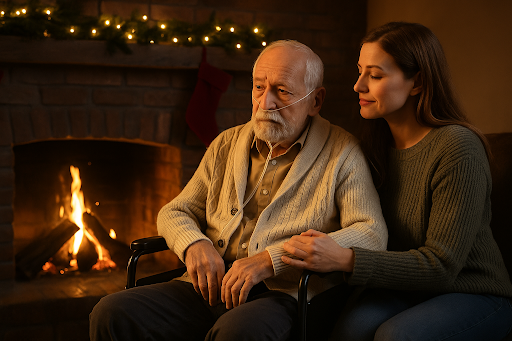
How Royal Hospice Supports You
At Royal Hospice, we deeply understand the many dimensions of grief during the holiday season. Here’s how we walk alongside families:
- We offer compassionate bereavement support and education to help you prepare for and navigate the holidays.
- Our team can guide you in designing meaningful remembrance rituals and adapting traditions to your current reality while honoring your loved one.
- We provide caregiver transition support, recognizing that when a loved one enters hospice, the family also begins a grieving process.
- Our circle of care continues after the loved one has passed. Too often, the holidays can feel the loneliest when others move on. We are here for your ongoing journey.
- If you’re a family member of someone in hospice care, we assist in identifying signs of emotional distress, connecting you with grief resources, and normalizing your experience of loss.
Tips for Families and Loved Ones Supporting Someone Who Is Grieving
- Listen first. You don’t need to fix the grief. Simply being present and letting them share can be more powerful than any words.
- Ask gentle questions. “I know this season may feel different, what can I do to support you?” or “Would you like to share some memories of [name] with me?”
- Respect boundaries. If they decline a gathering or tradition, that doesn’t mean they’re giving up, it may mean they are caring for themselves.
- Offer concrete support. “I’ll bring over dessert on the evening of December 20” is more helpful than “Let me know if you need anything.”
- Include, but don’t pressure. Invitation is important but so is autonomy. Let them choose when and how they participate.
- Remember the “non-holiday” days. For many, grief intensifies right after major holidays. Stay connected in the quieter days that follow.
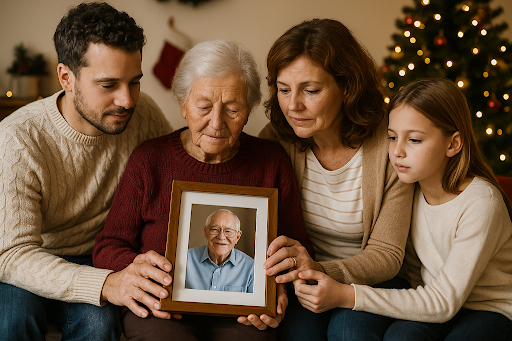
When to Seek Additional Help
While grief is natural and normal, there are signs that extra professional support may be needed. Consider reaching out if:
- The intensity of grief remains unchanged or grows overwhelmingly after several months.
- You find it impossible to engage in any part of your day (eating, sleeping, work, self-care).
- You’re experiencing thoughts of self-harm, suicidal ideation, or overwhelming despair.
- You notice an abrupt change in behavior (e.g., substance abuse, refusal to leave home, severe isolation).
- You are caring for someone in hospice and you’re suddenly feeling unable to manage the emotional load.
Looking Ahead: A Message of Hope
Grief does not mean you will never enjoy the holidays again. It means you will do so differently. The rhythm may change, the traditions will adapt, but your capacity for joy and connection remains. At Royal Hospice we hold this truth with you: your grief is the measure of your love—the depth of that love doesn’t vanish. Instead, you carry it forward.
This holiday season, may you find:
- Moments of pause to remember with tenderness.
- Spaces of connection that honor both your absence and your presence.
- Grace to let the season look different if it must.
- Gentle self-care that honors your humanity and your heart.
- The knowledge that you are supported—not only by your loved ones, but by a community of care.
Our team at Royal Hospice is honored to serve families who face the profound life transition of loss. If you or a loved one is navigating grief during this holiday season, whether it’s anticipation of loss, recent bereavement or long-standing mourning, please remember you don’t walk this path alone. Reach out. Let us walk with you, support you, and help you find meaning during holiday sorrow.
From our hearts to yours: May peace, comfort and meaningful connection find you this season and beyond.
What Actions Should I Take Next?
If you or your loved one has been advised to consider either Palliative or Hospice care, it is important to understand the options available to you. There are many companies to choose from, but it is critically important to find a company that is ethical and truly puts quality patient care at the forefront. Hospice Fraud is a real thing so make sure you do not feel pressured and understand all the benefits you and/or your loved one is elidable to receive.
If you’re considering hospice care or palliative care for a loved one, reach out to our team to learn more about your options. We’re here to support you during this challenging time as we believe in personalized care plans and a concierge approach to patient care. We call it “The Royal Difference”.
Please call or email us at (480) 626-4242 or info@royalhospice.com to see what other patients’ families say about our services as we are very proud of our 5 star google reviews. We will provide insight over phone from our Healthcare Advisor or will plan a time that works for you to meet with the patient and their family. We are here for you!
You can also see videos of the Hospice process and meet our team on our YouTube channel at www.youtube.com/@royalhospice.
Our company is a proud member of the National Hospice and Palliative Care Organization (NHPCO), supporting ethical, high-quality end-of-life care.
Our company is ACHC Accredited, an honor granted by the Accreditation Commission for Health Care (ACHC), which recognizes organizations that exceed care standards. The Centers for Medicare & Medicaid Services (CMS) only grants its coveted deeming authority designation to select national accreditation organizations that consistently exceed expectations.
Royal Hospice is also affiliated with Vital Palliative Care (www.vitalpalliative.com) and ComForCare Home Care in Scottsdale/Phoenix area of AZ. (www.comforcare.com/scottsdale). This enables us to provide a Continuum of Care to support family and patient’s needs.